What Is Natura 2000?
Natura 2000 is the largest coordinated network of protected areas in the world. Spanning all 27 member states of the European Union, it covers over 18 percent of the EU's land area and more than 8 percent of its marine territory. But unlike a national park, Natura 2000 does not mean "no entry". It is a network designed to protect biodiversity while allowing sustainable human activity -- including agriculture, forestry, and yes, responsible tourism.
The network rests on two pillars of European environmental law. The first is the Birds Directive of 1979, which protects wild bird species and their habitats. The second is the Habitats Directive (also known as the Flora-Fauna-Habitat or FFH Directive) of 1992, which safeguards a broader range of animal and plant species along with their natural habitats. Together, these two directives define which areas qualify for Natura 2000 designation and what obligations come with that status.
In Austria, Natura 2000 sites are managed by the individual federal states. Upper Austria alone hosts more than 30 designated areas, ranging from alpine meadows to lowland river corridors. The Lower Traun -- the stretch between Lambach, Stadl-Paura, and the confluence with the Danube -- is one of the most ecologically significant among them.
Why the Lower Traun Qualifies
The Lower Traun was designated as a Natura 2000 site primarily under the Birds Directive, as a Special Protection Area (SPA) for rare and threatened bird species. But the river corridor also supports habitat types listed in the FFH Directive: alluvial forests, natural riverbanks, and submerged aquatic vegetation that provide critical ecosystems for dozens of species.
What makes the Lower Traun exceptional is its combination of fast-flowing and calm water sections, steep gorge walls and flat riparian meadows, old-growth trees and gravel bars. This mosaic of microhabitats within a relatively short stretch of river supports a density of species that is remarkable for a Central European lowland river. The Traun Gorge section alone -- the dramatic canyon between Lambach and Stadl-Paura -- contains habitat types that have all but vanished from other Austrian rivers due to regulation and development.
The river's water quality is another factor. Fed by the limestone Alps and the lakes of the Salzkammergut, the Traun maintains excellent clarity and consistently high oxygen levels. This is visible to the naked eye: in summer, the emerald-green water reveals fish swimming several metres below the surface. For aquatic species, these conditions are not a luxury but a necessity. Many of the animals living in and along the Traun simply cannot survive in warmer, murkier waterways.
The Remarkable Species of the Traun Corridor
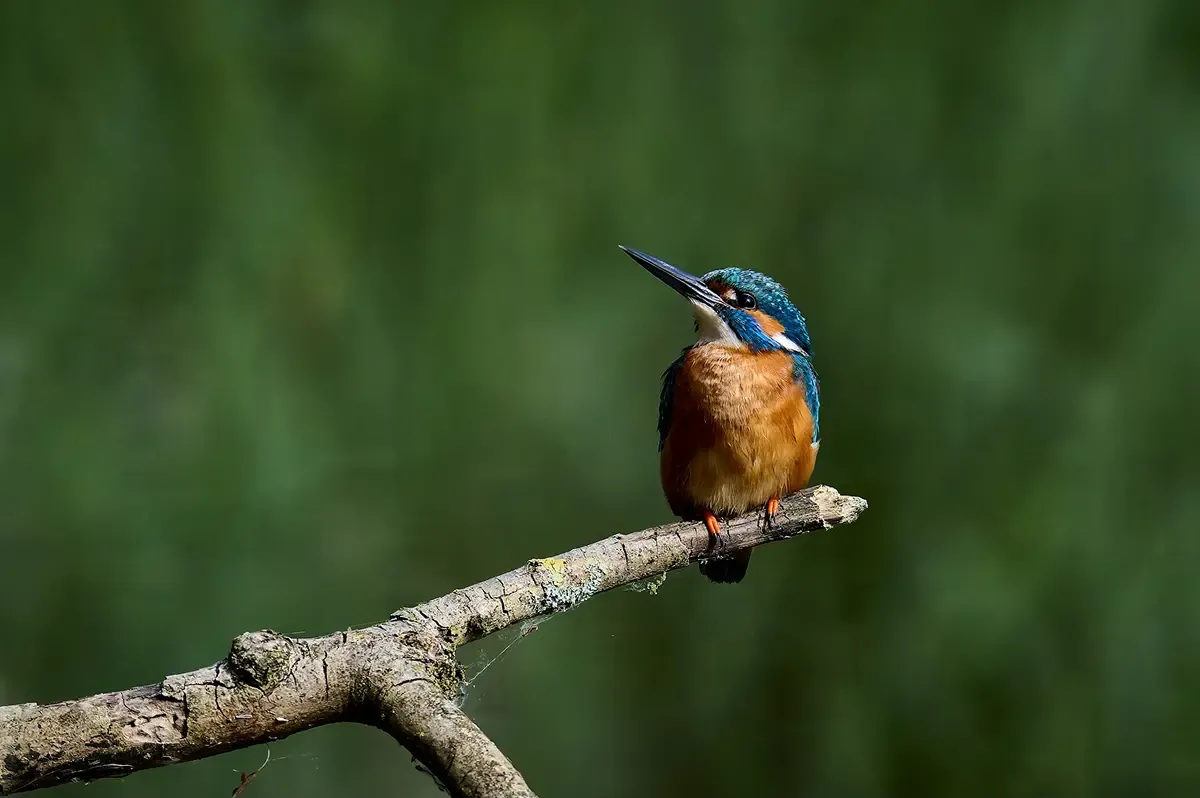
The undisputed star of the Traun is the kingfisher (Alcedo atthis). This electric-blue bird, barely larger than a sparrow, nests in the steep clay and sand banks along the river. It hunts by diving headfirst from a perch into the water, emerging a fraction of a second later with a small fish in its beak. On our paddle tours, sighting a kingfisher darting low over the water is one of the most common and most cherished wildlife encounters. The Traun supports one of the densest kingfisher populations in Upper Austria.
Less conspicuous but equally significant is the eagle owl (Bubo bubo), Europe's largest owl species. The rocky ledges of the Traun Gorge provide ideal nesting sites, far from human disturbance. With a wingspan of up to 170 centimetres, the eagle owl is an apex predator of the night. While daytime paddlers rarely see one, their deep hooting call can sometimes be heard echoing through the gorge at dusk.
Along the banks, the European beaver (Castor fiber) has made a quiet but remarkable comeback. Once hunted to near-extinction in Austria, beavers were reintroduced in the late 20th century and have since established stable populations along the Traun. Their lodges and dams are visible to observant paddlers as neatly gnawed tree stumps and carefully constructed stick piles near the waterline. Among the insects, the banded demoiselle (Calopteryx splendens) is perhaps the most beautiful -- a metallic-blue damselfly that flutters above the water surface in shimmering clouds during summer months.
"Natura 2000 is not a fence around nature. It is a contract between Europe and its landscapes -- a promise that development and biodiversity can coexist."
Sustainable Tourism Within Natura 2000
A common misconception is that Natura 2000 areas are off-limits to visitors. The opposite is true: the framework explicitly recognises that human activities, including tourism, can continue within designated sites as long as they do not threaten the conservation objectives. In fact, the European Commission has published guidelines encouraging sustainable tourism in Natura 2000 areas, recognising that visitor awareness and economic incentives are powerful tools for conservation.
At TraunXperience, we take this responsibility seriously. Our paddle tours are designed to be low-impact by nature: no motors, no noise, no emissions. We follow fixed routes that avoid sensitive nesting areas during breeding season. Our guides are trained to identify and respect ecological hotspots, and we brief every guest on the dos and don'ts of paddling in a protected area. This is not a burden -- it is part of the experience. Understanding why a particular stretch of riverbank is left undisturbed makes the tour richer, not poorer.
The Lower Traun region demonstrates that protection and access can coexist. Paddlers, anglers, hikers, and birdwatchers all use the river corridor, and the ecosystem thrives alongside this activity. The key is awareness, respect, and a willingness to adapt. When water levels are high and banks are flooded, we reroute. When a kingfisher nests near the put-in point, we keep our distance. When guests ask why we paddle quietly past a certain cliff face, we explain about the eagle owls nesting above.
Guidelines for Visitors: How You Can Help
Whether you join a guided tour or explore the region independently, a few simple rules ensure that your visit contributes positively to the Natura 2000 site rather than undermining it. Stay on marked paths and designated waterways. Do not land your boat on vegetated banks, especially between March and July when ground-nesting birds are raising their young. Keep noise to a minimum -- the gorge amplifies sound, and what feels like a normal conversation to you can be a disturbance to nesting raptors on the cliff above.
Take all waste with you, without exception. Even biodegradable items like fruit peels can attract species that do not naturally occur in the habitat, disrupting the food web. If you spot wildlife, observe from a distance. Resist the temptation to paddle closer for a better photograph. A kingfisher that abandons its perch because of an approaching boat expends energy it needs for hunting. Repeated disturbances can cause nesting failure.
Finally, share what you learn. The greatest threat to Natura 2000 sites is not tourism but ignorance -- a lack of public understanding about why these areas matter. When you return home from a day on the Traun and tell friends about the beaver lodge you saw, the gorge walls that shelter eagle owls, the damselflies that danced above your paddle, you become an ambassador for conservation. That ripple effect may be the most important contribution any visitor can make. To see it all for yourself, consider joining a guided paddle tour through the Traun Gorge.