An Ancient Path Through the Traun Valley
The Way of St. James -- the Jakobsweg -- is one of Europe's most celebrated pilgrimage routes. Most people associate it with the dusty trails of northern Spain, with Santiago de Compostela as the final destination. Yet the network of pilgrimage routes stretches far beyond the Iberian Peninsula. One of the most beautiful Austrian sections runs directly through the Traun Valley, past Lambach Abbey, along the banks of the river that has carried travellers for millennia.
The Austrian Jakobsweg follows several historic branches. The route through Upper Austria leads from the Salzkammergut via Gmunden and the Traun Valley towards Lambach, where it connects with the main route heading west towards Salzburg and beyond. Pilgrims have walked this stretch since the High Middle Ages, drawn by the promise of spiritual renewal and the practical necessity of following established waterways. The Traun served not only as a navigational guide but as a source of drinking water, fish and the cooling shade of its riparian forests.
What makes this particular section special is the way the landscape itself feels like a pilgrimage. The Traun carves through limestone gorges, passes beneath forested hillsides and opens into wide, gentle floodplains. Walking -- or paddling -- through this corridor, one experiences a constantly shifting panorama that has changed remarkably little since medieval travellers first trod the path.
Lambach Abbey: A Pilgrim's Haven
No account of the Jakobsweg in the Traun Valley is complete without Lambach Abbey. Founded in 1056 by Bishop Adalbero of Wuerzburg, this Benedictine monastery has stood on the banks of the Traun for nearly a thousand years. For pilgrims, it represented a critical waypoint -- a place of shelter, prayer and sustenance before continuing the long journey westward.
The abbey's Romanesque frescoes, dating to the 11th century, are among the oldest and best-preserved in Austria. They depict scenes from the life of Christ and were only rediscovered in 1967 beneath layers of later plaster. For art historians, they are a sensation. For pilgrims -- both medieval and modern -- they offer a moment of profound stillness, a visual meditation on faith that transcends the centuries.
Lambach Abbey also played a central economic role in the region. As a toll station on the salt route, it accumulated considerable wealth and influence. The monks maintained hospices for travellers and pilgrims, providing food and lodging. This tradition of hospitality continues today: visitors can tour the abbey, attend services and experience the same sense of arrival that pilgrims felt a thousand years ago. From the water, the view of the abbey's twin towers rising above the treeline is one of the most striking moments on any TraunXperience tour through the region.
Slow Tourism and the Pilgrim Spirit
Pilgrimage and slow tourism share a common philosophy: the journey matters more than the destination. Both reject the idea of rushing through landscapes, ticking off sights and moving on. Both demand a willingness to be present, to notice the small things -- the way light falls through beech leaves onto the water, the sound of a kingfisher diving, the feel of a paddle dipping into a current that has flowed since the last ice age.
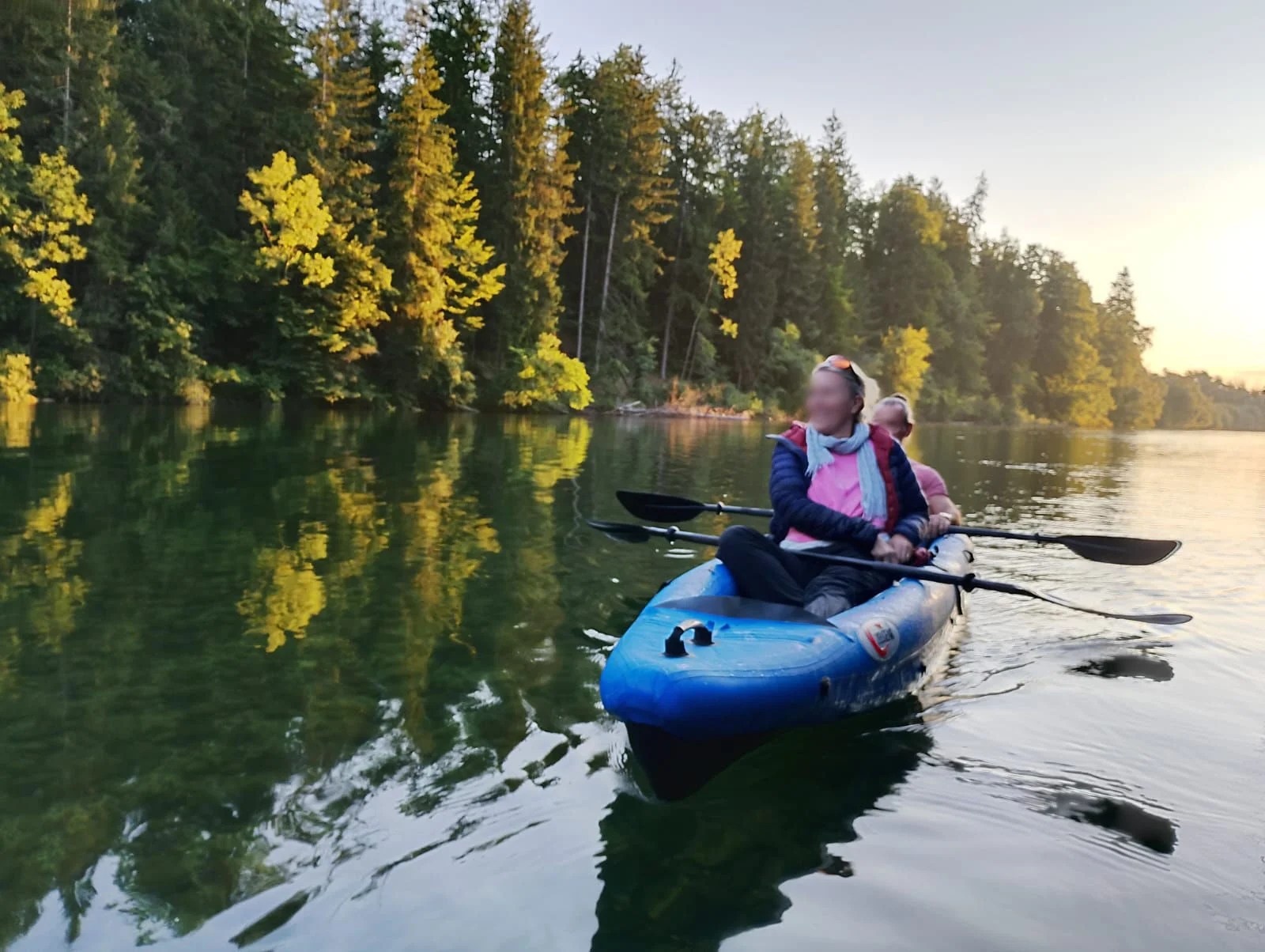
At TraunXperience, we believe that paddling the Traun is a form of modern pilgrimage. You travel at the speed of the river itself. There are no engines, no screens, no schedules to keep. The current guides you, and the landscape reveals itself gradually -- gorge walls giving way to open meadows, the call of a heron replacing the hum of a road. This is not adventure tourism in the adrenaline sense. It is adventure in the oldest sense: a journey into the unknown, undertaken with curiosity and respect.
"A pilgrim does not conquer the path. The path transforms the pilgrim. On the water, the same truth holds: you do not master the river -- the river teaches you."
The parallel between pilgrimage and paddling extends to the social dimension as well. Just as pilgrims formed communities on the road, sharing stories and helping one another over difficult terrain, paddlers develop a natural camaraderie. Navigating a gorge together, pulling boats ashore for a rest, sharing food on a gravel bank -- these small acts of cooperation mirror the pilgrim experience in ways that resonate deeply.
The Spiritual Dimension of Water
Water has always carried spiritual significance. In Christian tradition, it symbolises baptism, purification and renewal. In older, pre-Christian beliefs that persisted in Alpine folk culture, rivers were living entities -- guardians of the landscape, sources of both sustenance and danger. The Traun, with its origins in the glacial lakes of the Salzkammergut and its passage through deep gorges and sacred forests, embodies all these layers of meaning.
Paddling through the Traun Gorge, surrounded by walls of stone that are millions of years old, it is difficult not to feel something beyond mere recreation. The acoustics change: sounds become amplified, the splash of a paddle echoes, the song of a blackbird carries across the water. Many of our guests describe a sense of timelessness -- a feeling of stepping outside the relentless pace of modern life and into something older, slower, more fundamental.
This is not accidental. The Traun Valley lies within a Natura 2000 protected area, which means its ecosystems have been preserved with unusual care. The forests are dense and largely untouched. The water runs clean. Wildlife is abundant. Paddling here, you are not merely visiting nature -- you are immersed in it. And that immersion, like pilgrimage itself, has the power to shift your perspective in ways that are hard to articulate but impossible to forget.
Your Pilgrimage on the Water
You do not need to be a pilgrim in the religious sense to paddle the Jakobsweg section of the Traun. You do not need any paddling experience at all -- our guides will equip you with everything from boats to life jackets and provide a thorough briefing before you set off. What you do need is a willingness to slow down, to let the river set the pace and to be open to whatever the landscape offers.
The section of the Traun that TraunXperience covers runs from Stadl-Paura through the gorge and past some of the most historically significant sites on the Austrian Jakobsweg. Along the way, your guide will point out landmarks that pilgrims would have recognised centuries ago: the distinctive profile of Lambach Abbey, the remnants of old towpaths where boats were hauled upstream, the rock formations that served as natural waymarks.
Whether you come for the history, the nature, the exercise or simply the pleasure of spending a few hours on clear water surrounded by ancient forest -- the experience connects you to something larger. In the end, perhaps that is what pilgrimage has always been about: not arriving somewhere, but being fully present on the way.