White Gold and the River Traun
Anyone gliding through the Traun Gorge by paddle boat today can barely imagine that a multi-million-dollar trade once operated on this very waterway. Salt -- "white gold" -- was one of the most valuable commodities in the Middle Ages. It preserved food, served as currency and made entire regions wealthy. The Traun was the most important transport artery for this trade: from the Salzkammergut, the water route led through Gmunden, Lambach and Stadl-Paura all the way to the Danube.
The organised salt trade on the Traun was first documented as early as 1311. But the significance of this river as a trade route reaches back much further. The Celts and Romans already used the natural gradient of the Traun to transport goods downstream. With the rise of the salt mines in Hallstatt and Bad Ischl, the Traun became the most important transport route in Upper Austria.
Stadl-Paura: The Transhipment Hub
The name "Stadl-Paura" already reveals the function of the place: "Stadl" derives from the German word for large storage buildings -- the warehouses where salt was temporarily stored. Here, where the Traun flows more gently and the banks were flat enough for loading and unloading, an important transhipment hub developed over centuries.
The salt boats -- known as "Platten" and "Zillen" -- arrived loaded from the Salzkammergut. In Stadl-Paura, the salt was transferred from river boats to carts or larger Danube vessels. On peak days, up to 300 tonnes of salt were handled. This brought employment, prosperity and a distinct professional class: the boatmen, or "Schiffleute", who were indispensable as skilled helmsmen on the sometimes wild Traun.
Those wishing to learn more about the lives of these boatmen will find a fascinating collection of tools, documents and models at the Schiffleutmuseum (Boatmen's Museum) in Stadl-Paura. The museum tells stories of the harsh daily life of the river boatmen, the dangers on the water and the close bond between people and river. A visit is especially worthwhile when combined with a boat tour through the region.
Architecture of the Salt Warehouses
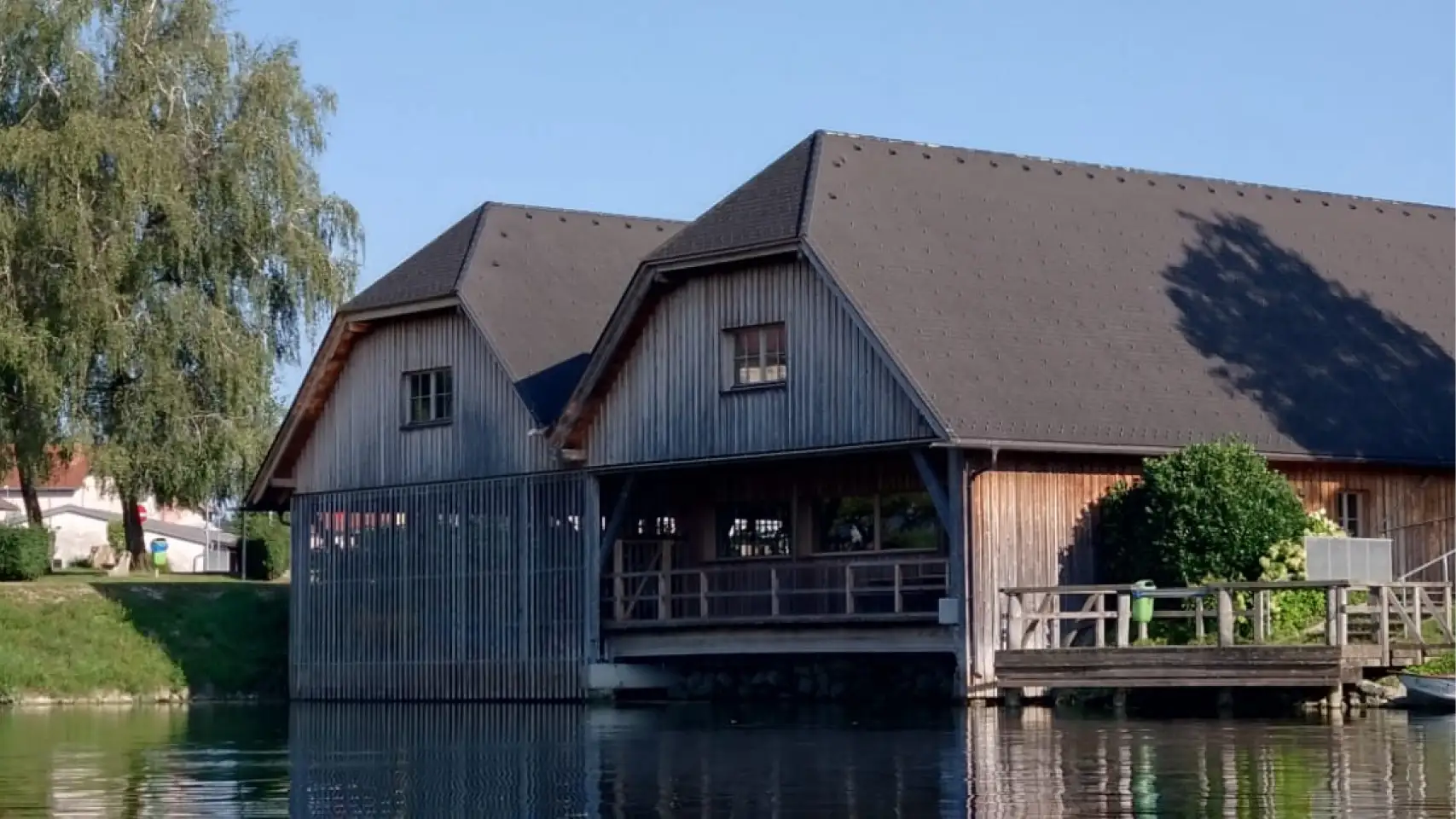
The salt warehouses themselves are impressive witnesses to medieval building craft. Their massive stone walls, high gabled roofs and well-designed ventilation were not stylistic choices but functional necessities. Salt is sensitive to moisture -- the warehouses had to keep the commodity dry while being ventilated enough to prevent dampness from accumulating.
The buildings were constructed from local limestone and timber, materials sourced directly from the surrounding area. The steep gabled roofs allowed rain and snow to drain quickly. Narrow ventilation slits in the gables ensured a constant airflow. Some of the warehouses were so large that they could store up to 1,000 tonnes of salt -- a logistical feat for the era.
"The salt warehouses are more than storage buildings. They are stone witnesses to an era when Upper Austria became the hub of European salt trade."
The Trade Route: From Mountain to Sea
To understand the significance of the salt warehouses, one must know the entire trade route. The salt was mined in the tunnels of Hallstatt and Ebensee. Via Lake Hallstatt and the Traun, it travelled downstream -- first to Gmunden, where the first major transfer took place, then on to Lambach and Stadl-Paura.
From Stadl-Paura, the route continued via the Traun to the Danube. There, the salt was loaded onto larger cargo vessels and transported to Vienna, Pressburg (Bratislava) and as far as the Black Sea. Upper Austria thus lay at the centre of a trade route that spanned Europe. Lambach Abbey, just a few kilometres upstream, profited enormously from toll and customs revenues and developed into one of the most powerful Benedictine monasteries in the Danube region.
This historic route can still be felt today -- especially from the water. Those who paddle through the Lower Traun with TraunXperience essentially follow the same stretch that the salt boats once navigated. Only quieter, slower and with an entirely different perspective on the landscape.
Decline and Rediscovery
With the advent of the railway in the mid-19th century, the Traun lost its importance as a transport route. The Western Railway, which ran through the Traun Valley from 1860, could transport salt faster, cheaper and regardless of weather conditions. Within just a few decades, the salt boats vanished from the Traun. The boatmen lost their livelihoods, the warehouses were no longer needed.
But what would demolition have meant? The loss of a unique cultural monument. Fortunately, the historic value was recognised early enough. The salt warehouses are now listed buildings and have been partially restored. They serve as event venues, museum spaces and as a visible reminder of an era that shaped Upper Austria like no other.
The rediscovery of the Traun as an experiential space -- for paddlers, nature observers and cultural enthusiasts -- connects to this long history. When we at TraunXperience speak of "slow tourism", this is precisely what we mean: taking time, looking closely, understanding. The salt warehouses are more than a tourist sight. They are proof that the Traun has been connecting people for centuries -- whether as a trade route or as a place of encounter with nature.