Why Outdoor Team Events Work
The annual company outing is more than a line item in the HR budget. Done well, it strengthens relationships, breaks down departmental silos and gives employees a shared experience that carries over into daily collaboration. Done poorly -- a lukewarm buffet in a conference room, a forced icebreaker, a bus ride nobody wanted -- it can do more harm than good.
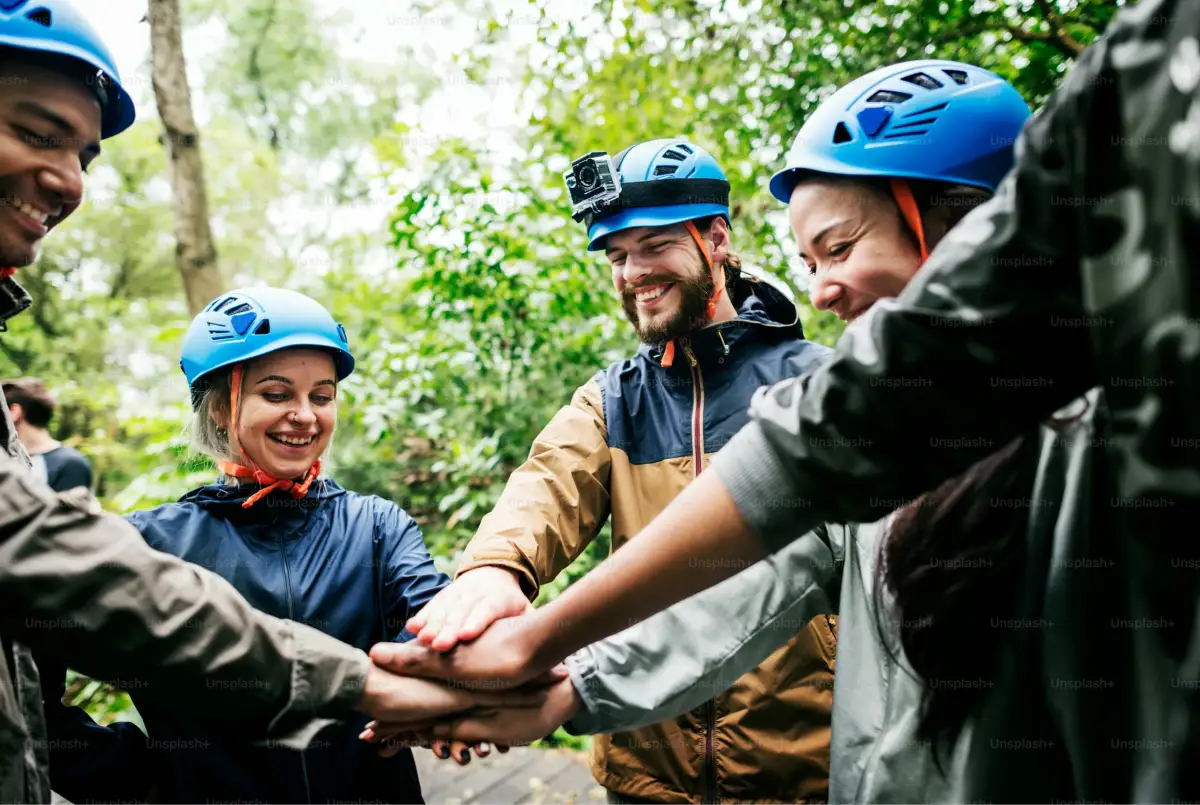
Research consistently shows that outdoor activities produce the strongest team-building outcomes. When people are removed from their usual environment and placed in a setting that requires cooperation, communication and a degree of physical engagement, they relate to one another differently. Hierarchies flatten. The quiet colleague in accounting turns out to be a confident paddler. The team lead who runs every meeting discovers the value of following someone else's rhythm.
Upper Austria offers an ideal landscape for this kind of experience. The Traun Valley, in particular, combines accessible water sports with stunning natural scenery and a rich cultural backdrop. A day on the river is not just fun -- it is genuinely memorable, which is precisely what separates a good company outing from a forgettable one.
Step 1: Timeline and Early Planning
The single most common mistake in planning a company outing is starting too late. For a group of 15 to 50 people, begin planning at least eight to ten weeks in advance. For larger groups or peak-season dates (June through August), twelve weeks is safer. This allows time for venue availability checks, participant surveys, budget approval and the inevitable back-and-forth with management.
Start by fixing the date. Mid-week outings (Tuesday to Thursday) tend to have better availability with outdoor providers and lower pricing. Avoid Mondays, when people are catching up on work, and Fridays, when early departures are tempting. If your team includes part-time workers or parents, a weekday morning-to-afternoon format works better than an all-day affair.
Create a simple timeline: week one for concept and budget approval, weeks two and three for booking the venue and activity, weeks four through six for participant communication and logistics, weeks seven and eight for final confirmations and contingency planning. Share this timeline with your stakeholders early -- it prevents last-minute chaos and demonstrates professionalism.
Step 2: Budget and Programme
Budget transparency is essential. A realistic per-person budget for a quality outdoor team event in Upper Austria ranges from 50 to 120 euros, depending on the activity, catering and transport. This typically covers a guided activity (such as a paddling tour), equipment rental, a group lunch or barbecue, and basic transport coordination.
When presenting the budget to management, frame the outing as an investment in retention and team cohesion rather than a cost. Include comparable figures: the average cost of replacing an employee in Austria is roughly six to nine months of salary. A team event that measurably improves satisfaction costs a fraction of that.
"The best company outings do not feel organised. They feel like a day off that happens to make the team stronger. The secret is choosing an activity that is genuinely enjoyable -- not one that merely looks good on the intranet."
For the programme, aim for a clear structure: arrival and welcome (30 minutes), briefing and equipment distribution (20 minutes), the main activity (2 to 3 hours), a shared meal (1 hour) and a relaxed wrap-up. Avoid overscheduling. Leave buffer time between blocks. Adults, like children, need unstructured moments to bond naturally.
Step 3: Participant Information and Safety
Once the programme is set, communicate clearly with participants. Send a first announcement four to six weeks before the event with the date, rough programme and what to expect. Follow up two weeks before with detailed logistics: meeting point, dress code, what to bring, what is provided and any health or fitness requirements.
For a paddling event on the Traun, the requirements are minimal. Participants need no prior experience. TraunXperience provides all equipment -- boats, paddles, life jackets, dry bags. Participants should bring sportswear or outdoor clothing, sturdy shoes that can get wet (no flip-flops), sunscreen, a change of clothes and a water bottle. A detailed packing list should be part of your communication pack.
Address safety proactively. Share the provider's safety concept and insurance details. For TraunXperience events, all guides are certified, life jackets are mandatory and the route has been risk-assessed for corporate groups. If any participant has a medical condition that affects physical activity, request this information confidentially in advance so the guide team can adapt accordingly. You can download our regional safety information for reference.
Step 4: Travel and Logistics
Transport is often the weak link in company outing planning. If your team is based in Linz, Wels, Salzburg or the greater Upper Austrian region, the Traun Valley is reachable within 30 to 60 minutes by car or bus. For groups over 20, a chartered bus is the simplest option -- it eliminates parking issues, ensures everyone arrives together and allows for a relaxed return journey.
If participants are driving individually, provide precise GPS coordinates for the meeting point, not just an address. Include parking information and a contact number for the day. For teams travelling by train, Lambach station is on the Westbahn line and within walking distance of the put-in point. TraunXperience can coordinate shuttle transfers from the station for larger groups.
Plan the return logistics before the event, not during it. After two to three hours on the water plus a meal, people are pleasantly tired. Having the bus waiting at the take-out point or a clear parking plan prevents the day from ending on a logistical low note. The last impression is the lasting impression.