The summer of 2026 will go down in the record books: the hottest since measurements began, with months of far too little rain. Streams ran dry, rivers sank to historic lows. And right in the middle of it all, the Traun near Lambach just kept on flowing as if nothing had happened. Here's why that's no coincidence – and why paddling here (almost) always works.
A summer like Austria had never measured
By spring it was clear this year would be different. In May, the state of Upper Austria reported its first dried-up waterways, such as the Hainbach in the Mattig valley. According to WWF, the Vöckla river at times carried almost 90 per cent less water than its long-term average. Then came summer: according to GeoSphere Austria, the hottest since records began, with around a third less rain than usual. In Upper Austria it was almost three degrees above average.
The effects were everywhere. For weeks the Gusen in the Mühlviertel was little more than a trickle, stones lay dry in the sun along countless streams, and nearly nine out of ten groundwater gauges showed low or very low levels. Paddlers all over Austria left their boats in the basement – there simply wasn't any water.
This is no longer an outlier but a pattern. Climate change is making hot, dry summers more frequent and more extreme – experts have been saying so for years, and in 2026 everyone felt it at the end of their garden hose.
And the Traun? At least 12 m³ per second
While water levels elsewhere plummeted, we noticed something remarkable on our stretch between Traunfall, Kemating and Lambach: even on the driest days of the summer, the Traun never dropped below around 12 cubic metres per second.
12 m³/s
That's no coincidence: the power plant operator Energie AG is required to let at least 12 m³ of water per second pass through. In other words: paddling here always works.
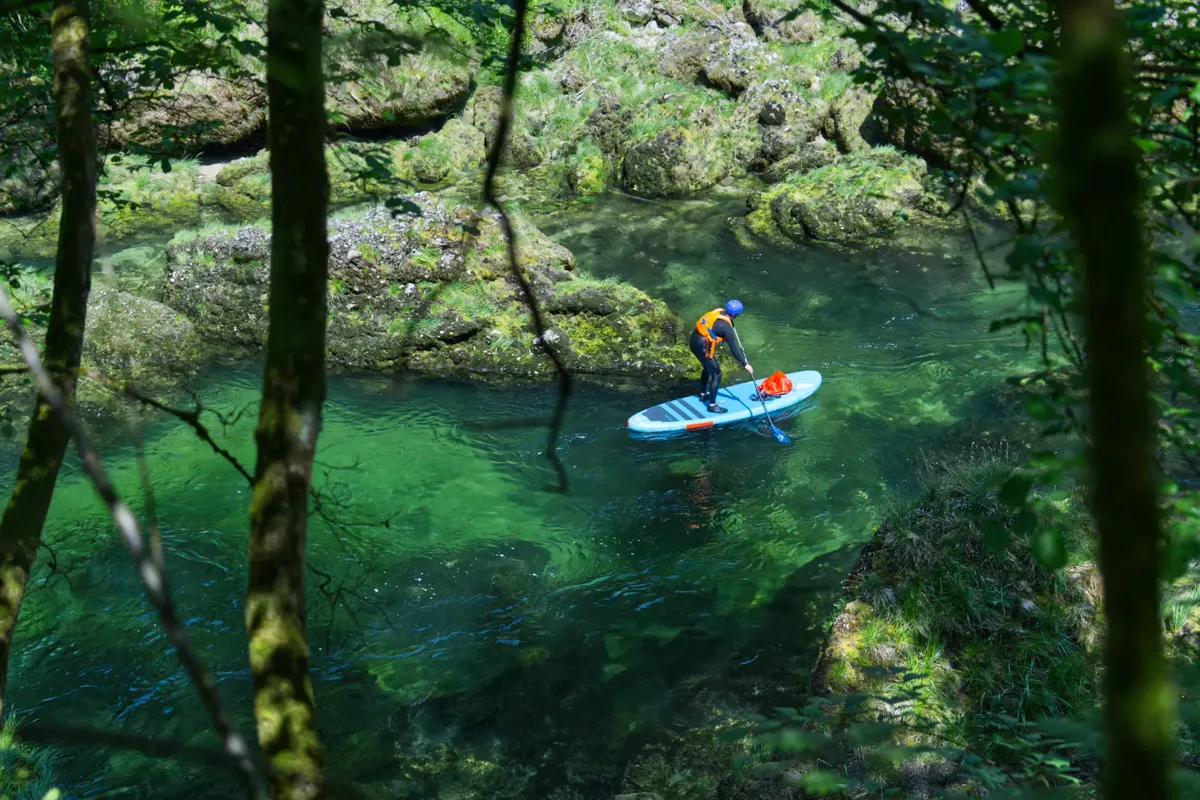
To put that in perspective: 12 m³ is 12,000 litres – every second. That's a full bathtub, eighty times a second. Plenty of water to glide through the Traun Gorge by raft, to paddle your SUP over the gravel banks and to stand waist-deep in cool, clear water during the swim break.
Why the Traun? Three reasons from the mountains
1. The lakes as giant reservoirs. The Traun doesn't live off last week's rain. Before it reaches us, it flows through Lake Hallstatt and Lake Traunsee. These lakes act like huge buffer tanks: they collect water in wet periods and release it steadily when it turns dry.
2. The karst mountains as a sponge. The Traun's catchment reaches up into the Dachstein massif and the Totes Gebirge. This limestone is riddled with caves and fissures and soaks up rain and meltwater like a sponge. Through springs, the mountains slowly release that water over weeks and months – exactly when it has long since dried up elsewhere.
3. A large catchment area. Almost the entire Salzkammergut drains into the Traun. Whenever it rains anywhere between Bad Aussee and Gmunden, that water reaches us sooner or later. Small lowland streams have no such reserve – which is why they're the first to run dry.
Are the power plants to blame?
Time and again we hear that Energie AG and its many hydropower plants are to blame for the low water levels. It sounds plausible – but it isn't true.
A hydropower plant doesn't use up water: it only uses the gradient – what arrives upstream flows on downstream.
Winters with little snow, hardly any meltwater in spring, plus heat and too little rain: less snow in the mountains means less water in the valley.
Good to know: low water hits the power plants too
If you think power plants benefit from low water, think again: low water is a real problem for the operators themselves.
Run-of-river plants can hardly store water. In summer 2026, hydropower output at Verbund was around 30 % below average, and many small plants had to throttle or shut down completely. The reason, according to Verbund: less and less snow is falling.
The invasive quagga mussel has been found in Lake Traunsee since around 2020 and in the Traun since 2022. Calm, warm water suits it. It overgrows pipes, filters and water intakes – a costly problem for water suppliers and power plants.
The larvae travel on boats and gear. Before paddling somewhere else: clean everything thoroughly, ideally with hot water (at least 45 °C), and let it dry for at least four days. And: the sharp shells can cut – water shoes help.
Sources: Province of Upper Austria – quagga mussel (German) · APA, 30 July 2026 – low water stops power plants (German)
Thank you, Energie AG!
Energie AG is an important partner for TraunXperience. We're very grateful for their expertise and support, which give us access to the water – so here's a big, official thank you!
No reason to be complacent
As great as it is to have a reliable river on our doorstep, the Traun isn't invulnerable either. The Dachstein glaciers are shrinking, and hot summers warm the water – that's stress for fish and everything else living in the river. Especially in a Natura 2000 protected area, that means for us: be considerate, respect quiet zones, leave nothing behind. Learn more about what makes this area special in Natura 2000 explained and in our article on the riparian forest of the Traun.
But the dry summer of 2026 also shows how valuable intact nature is: lakes, karst and floodplain forests that store water rather than just passing it on. They're our best insurance for the summers still to come.
What it means for your tour: it always works here
In practice, that means: when rivers elsewhere are empty, the Traun near Lambach is a safe bet. At lower water the river is calmer, the water especially clear, and the gravel banks turn into big, sunny spots for a break. Our guides know the line at every water level – that's part of our route too.
You can check the current water level any time on our home page; the readings come straight from the state hydrographic service. And if you want to know why paddling the Traun is every bit as good as a trip abroad: Traun instead of Vltava.
So when the next heatwave summer comes – and it will – you know where the water is.