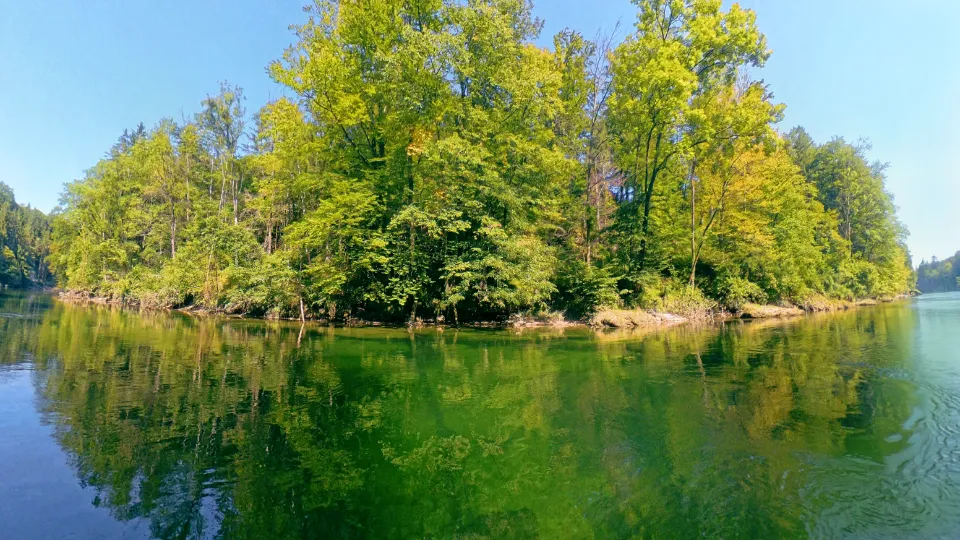
A few steps from the pool edge of Lambach’s outdoor pool, the Traun flows by – alive, different every day, on its way for thousands of years. For generations, people swam in the river as a matter of course, and that old longing is coming back: back to the roots. Food for thought about river swimming in the Traun – and an invitation to the region.
Summer Used to Smell of River, Not Chlorine
Ask your grandparents where they learned to swim. The answer is rarely a tiled pool. It was a river, a stream, an oxbow – water that came from somewhere and flowed on somewhere else. River swimming was as natural on the Traun as a trip to the pool is today: gravel banks for sunbathing, a plunge into cold, living water, then goosebumps and a sandwich with sandy fingers. Summer smelled of river, of wet stone and riparian forest – not of chlorine.
This memory is not nostalgia-tinted glass. For generations, swimming in natural waters was the norm across Europe, not the exception – wooden bathing jetties, changing huts on the bank, swimming spots in calm bays. The people of this region lived with their river for centuries: as a trade route for salt, as the workplace of the boatmen, as a place to swim on hot days. Only when rivers suffered under industry and sewage in the 20th century did bathing move into the pool. For good reason back then. But on the Lower Traun, that reason is largely history. The river has recovered. And with it returns a question nobody has asked for a long time: why do we only swim in pools any more, when the river flows right next door?
That is exactly what this article is about. No attack on anyone, no demands – and certainly nothing against the pool. An invitation to think out loud: about river swimming culture and natural bathing in Upper Austria, about the Traun on our doorstep – and about what we lost when water became rectangular.
Two Bathing Worlds, One Embankment Between Them
In Lambach, these two worlds lie closer together than almost anywhere else. On one side the outdoor pool: diving board, sunbathing lawn, the smell of fries, the familiar squeak of wet feet on tiles. On the other side, just beyond the embankment, the Traun – wide, shimmering green, in motion.
We know this place well: the meeting point for our tours is, of all places, the car park at the Lambach outdoor pool. Pool and river could hardly be closer – literally and figuratively. And we say this without any irony: this pool has shaped generations. First swimming strokes, first head-first dives, whole summer holidays on the lawn. That deserves respect, not mockery.
And yet there remains that observation which almost forces itself on you when you stand at the pool edge and hear the river rushing behind it: we swim our lengths between tiles – and a few steps away flows a river that hardly anyone touches any more.
What the River Does All By Itself
All over Europe, people are currently discussing how man-made bathing facilities can best move into the future – technology, energy, staff, renovations: built infrastructure wants to be maintained, year after year. That is not a Lambach issue but a general one, and it is not for us to judge – the municipalities themselves know best. What interests us here is something else: the water that flows right next door and is so often overlooked.
Because the Traun needs none of that. It renews its water by itself, every second, and has done for thousands of years. It knows no opening hours, no winter closure, no maintenance intervals. What it costs is not money but something else: respect, knowledge and a little humility. More on that in a moment.
To be clear right away: this is not an argument against the pool – it is an argument for the river. As a natural alternative for everyone who likes it wild and alive, not a replacement. Pool and river: a new, honest relationship with the water that is there anyway – in addition to everything that already exists.
Basel Swims in the Rhine, Bern in the Aare. And Us?
That river swimming culture is no nostalgic fantasy becomes clear with a glance at Switzerland. In Basel, swimming down the Rhine is as much a part of summer as ice cream: on hot days, thousands float downstream, their clothes packed watertight in the famous Wickelfisch, the swimming dry bag that has long become a symbol of the city. In Bern it is the Aare – and the tradition-rich Marzili lido lies right on its bank: an outdoor pool and a river that don’t exclude each other, but complement each other.
The remarkable thing: neither is a niche scene, but everyday life in cities that could afford any pool in the world. They still swim in the river – because it is more beautiful. Because a river carries, cools, moves and tells stories in a way no pool can. And because a city that turns its river into a swimming spot develops a different relationship with its water: whoever swims in the river wants it to stay clean.
Of course, the Traun is not the Rhine and Lambach is not Basel. But the basic idea cannot be argued away: river swimming culture works, in the middle of Europe, in the 21st century. You just have to want it – and organise it wisely.
River Swimming in the Traun: The River is Back
The most important prerequisite has long been met. After decades of upgrades to sewage plants and industrial sites, the water quality of the Lower Traun has improved significantly – on hot summer days, the river is once again a popular swimming spot in many places. Anyone who has stepped off the gravel bank into the clear, turquoise-shimmering water of the Traun Gorge understands immediately why. That first moment when your breath catches and your body is wide awake – no heated pool can replace it.
Add to that what no pool in the world can offer: the Lower Traun flows through a Natura 2000 European protected area – riparian forests, gravel banks, steep bluffs. With a little luck, the kingfisher shoots across the water like a blue flash, demoiselles dance above the surface, goosanders drift downstream with their young. What this protected area means is explained in our post Natura 2000 explained – and if you want to know what lives in the green thicket along the bank, you’ll find it in The Riparian Forest of the Traun.
And the river has moods the way a theatre has performances: mist in the early morning, a glittering midday, golden evening light on the conglomerate walls of the gorge. A May that tastes of meltwater, a slow, warm August, a golden October when the riparian forest burns with colour. A pool has opening hours – a river has moments. To find out which one is yours, visit our page on the times of day on the Traun.
A River is Not a Pool: Respect is Part of the Deal
And now the part that matters more to us as guides than any romance – because without it, this plea would be reckless. A river is not a pool; that is its magic and its seriousness at once. Even in high summer, the Traun carries fresh, cool water; it has current, eddies and levels that can change quickly after rain in the Salzkammergut. That is exactly what makes it alive – and exactly what demands something nobody needs at the pool: local knowledge.
River swimming culture therefore starts with river knowledge. Never alone into unknown water, never when levels are high, never without reading the current – and always with a life jacket when you’re out on the water. It also means: swimming is not allowed or advisable everywhere. Rules apply in the protected area, sensitive bank zones need quiet, and the areas around weirs and power plants are strictly off limits. If you swim, inform yourself first. We have summarised the most important principles in our 10 golden rules for water sports, and you’ll find our safety concept under Equipment & Safety.
In Basel and Bern, precisely this safety culture is taken for granted – it is not a contradiction of freedom, but its precondition. Respect is not a hurdle on the way to the river. It is the way.
The Bridge to the River: Safely Back to the Water
Between “never been in the river” and “at home in the river” lies a path – and nobody has to walk it alone. That is exactly why we exist: TraunXperience sees itself as the bridge to the river. On our guided tours you get to know the Traun from its most accessible side – in a raft or on a SUP, with guides who know every metre of our route through the protected area, with life jacket and briefing. And with swimming breaks exactly where the water is calm and deep enough. Many of our guests board the boat as pool swimmers and step out as river people.
For children especially, this is more than swimming fun: those who get to know the river accompanied and secured learn along the way what current feels like and why you read water before jumping in. That is not danger, that is education. We have dedicated tours for families, and what a day on the river costs is laid out transparently on our prices page.
And the pool? It remains what it is: the best place to learn to swim, for morning lengths, for the plannable family afternoon. Pool and river are not competitors – they complement each other, just as in Bern the Marzili lido and the Aare have lived side by side for as long as anyone can remember.
What Now? An Open Question – and an Invitation
Which leaves the open question: do we want to bring the river back into our lives a little more – or is everything fine as it is? We don’t have a ready-made answer, and we don’t want to deliver one. Questions like this are not decided in a blog article, but in conversations – at the regulars’ table, on the gravel bank, in the region.
But asking is allowed. Would you like well-kept, safe access points to the river, following the example of Basel and Bern – in addition to everything that already exists? Or do you say: everything is fine just the way it is? Both are legitimate, and we are happy to hear both. Either way, the Traun keeps flowing, every day, alive and free. It is in no hurry. By the way: why the best river experience often lies right on your doorstep rather than across the border is something we have written about before – in Traun Instead of Vltava.
Our suggestion: form your own judgement – on the water, not on paper. Book a tour, get in the boat with us and feel for yourself, during the swimming break on the gravel bank, what back to the roots feels like. And then tell us what you think – by email, on social media, or best of all in person at the meeting point. Because there is one thing you cannot settle from the pool edge: what the Traun really feels like. You only know once you’ve been in.